
July 2026 - Drifting Reflections
Welcome! Maybe it's the heat, maybe it's the drinks, but July's got us introspective. This issue marks Carouse's first interview as our own Kati B. picks the brains behind megagame phenomenon Baseline Drift. Later: a retrospective on running con games and a review for some strangely intimate bio-horror. Whether you're new or returning, there's always a seat for you at our table. Enjoy!
Roll to Carouse!
- Lighten your coin purse at the Projects Pavilion.
- Pilfer ideas from the Blog Bazaar.
- Languish in the Opinion Oubliette.
- Hear the raving of Reviewers Row.
Projects Pavilion ⤴
VIOLENCE IN JULY jam hosted by Luke Gearing
The Violence in July jam is running for the duration of the month, focused on content for Luke Gearing's minimalist ruleset. - Markus M.
Appx. N Jam 2026 hosted by Dark Dungeons
The Appendix N jam returns, for small projects with assigned names inspired by the pulp literature of the original Appendix N - Markus M.
A few of us are working hard on our Appx. N submissions! I plan on shouting out my favs in greater depth once the jam ends, but for now, here are a few early submissions with some sauce: The Anvil of Winter, Spell of the World-Weavers, Warriors of the Bleached Basin, and Zepar's Weirding. If you're still working on your submission, good luck! 🫡 - Taylor B.
Blog Bazaar ⤴
Mud Men of Moresby by Danny Fist
Quick introspection on the author's recent submission to the Frontier Scum game jam. A great read in any season, but especially our current jam season. Most important IMO is the first lesson Danny covers: asking questions early and often. Something as simple as "if this is true, what else is true?" is a powerful creative spark. - Taylor B.
The Thoughtlessness of Deathbringer's Marketing and The Thoughtlessness of Deathbringer's Sales Pitch by Magnolia Keep
In a two parter for the ages, Liz of Magnolia Keep skewers the Deathbringer campaign with her usual biting wit. A real masterclass in marketing mistakes. - Markus M.
I hate playing at most OSR tables by Ms. Quixotic
A short, punchy post covering what the author wants (but isn't getting) from the often methodical, often masculine dungeon crawler scene. Resonant for me as someone who loves running lethal exploration sites but much prefers playing GM-less storygames. It's not a control thing it's not cope I'm actually cool and chill I promise 😌 - Taylor B.
Learning to Draw and Not Feeling Like Crap About It by Weeping Stag
Part entry-level advice, part retrospective on a recent hobby, this post covers lessons learned in the author's year-and-some-change long attempt to improve their drawing skills. They're a composer by trade and specifically approached this challenge with the desire to "be a novice at an art form again." It's an idea that feels deeply tender and also makes them well equipped to pass on advice to anyone in a similar position. - Taylor B.
Worker Placement Manifesto from Traverse Fantasy
We don't get many D&D posts from Marcia these days, so this is a treat! Here she writes about changing expectations around collaboration between characters during dungeon crawls. A great brisk read! - Rowan H.
Opinion Oubliette ⤴
Spaceside Chat with Baseline Drift Creators
by Kati B.
Recently, I had the awesome opportunity to be a moderator for Baseline Draft (BLD), a game inspired by Over/Under (OU) which is based on Sam Sorensen's Cataphracts. Similar to OU, the setting was in space, but the players are aboard the Navis Caeli, a ship that's left a burdened Earth. The ship has been in orbit for hundreds of years and should have landed by now.
Mechanically, the game features 6 major factions with each having 3 Leaders and 3 Deputies with leaders having a special ability. Every major faction has a Headquarters (HQ) they must protect and the ability to raise squads of soldiers to take other sectors of the ship. It takes time to raise squads and with how small the ship is, alliances must be forged.
Unlike OU, the player cap for BLD was set to 300 players though it didn't quite hit that mark. The creators, Just Kaylee and Yakamo, were happy to sit down and answer some questions I had about the mechanics, their favorite relationship, and what they're taking forward into what might be Baseline Drift, Season 2.
For each faction, why did you place the HQs where you did?
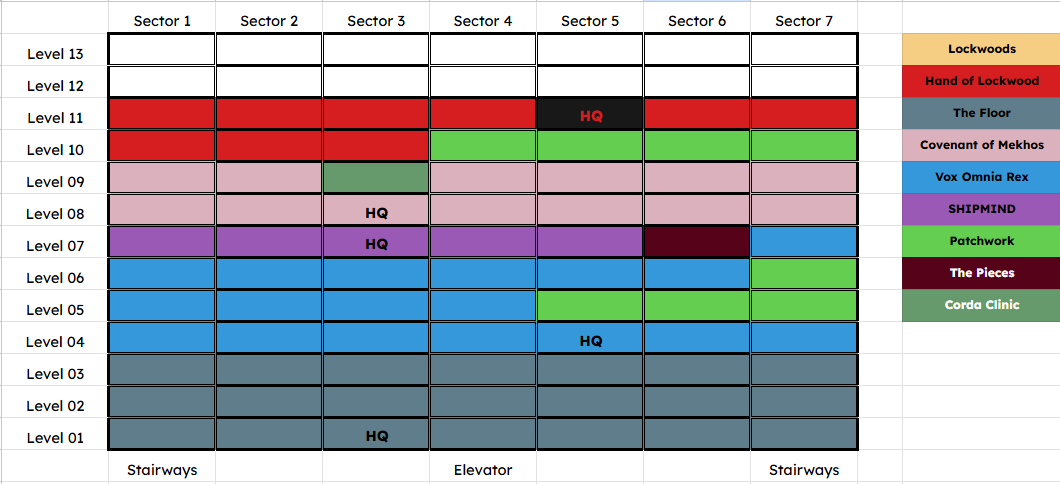
Just Kaylee: We chose to place them in all one spot over from the elevators as evenly as we could to get each faction a fair chance. This is with the exception of Shipmind and Mekhos who were mechanically similar in function / lore being able to access the same computer systems.
Yakamo: The HQs were places with a mix of balance and story in mind. Some HQs were placed far away from each other because we knew those factions were inclined to be allies and wanted them to have some initial distance. Others we kept near, like SHIPMIND and Mekhos, to imply a connection. We also wanted to keep a relative equal distance from stairwells and elevators so no faction was at a major disadvantage when it came to ambushing.
Squad management was more fluid than I expected. Why was it possible to give open-ended standing orders for squads rather than selecting from a preset of actions?
Yakamo: I think technically there were really only two options: move and attack. We allowed leaders to decide if their squads were standing ready to fight anyone passing by or were neutral.
Just Kaylee: Going in with the idea of near unlimited player choice was a big idea for us. Rules as written though soldiers technically only had "attack, act neutral, or retreat from hostiles" but of course we let people give really specific orders for soldiers. Rule of Cool?
Yakamo: Squad actions moving at an hourly pace was tough. We wanted it to be faster than standard cataphracts because the game is much shorter but the hourly pace put more pressure on the wardens and leaders than needed. Maybe having 4 time chunks: morning, noon, evening, and night would work better.
Would you make any changes to the economy in Season 2? Follow-up to that. Even though you and some players were aware of the economy loophole, were you disappointed when it was taken advantage of? [Note: The Floor, a faction who controlled a currency exchange of Floor Coin to Credits, could go into the negative with Floor Coin and set the exchange rate between the two. For example, they could set the Floor Coin exchange rate to 1 coin = 1 trillion credits, then withdraw the Floor Coin and exchange one effectively earning 1 trillion credits.]
Just Kaylee: The entire economy would be different I think. I would make much more clear stages for when the game seems to start to have inflation, the more money going around should have gradually caused upkeep to be more. We had some preplanned events like this but there should have been more.
Yakamo: The leaders of the Floor realized they had a loophole to create infinite credits before the game began. We hoped they wouldn’t notice… but they did. We assumed they would choose not to do it or only deploy it as a nuclear option but it ended up being used very early. I think there is a very real version of this game that functions without an economy. I think we can set up other stakes and resources to better serve the narrative of the next season. Currency may stay as a legacy so that non-leader characters can have a resource to trade around though!
Just Kaylee: Oh I was personally very disappointed! But I also was the one who made the call not to fix it so it's sort of on me haha. The disappointment is not on the players for using the system but for not fixing it (and later needing to change major parts of the bot midgame).
Note: The reason the bot was not fixed was due to the loophole being pointed out too close to game start.
How did you handle rubberbanding, especially with detail-oriented operations going on all the time? [Note: Rubberbanding is when orders are put in but not yet executed even though the in-game time has moved on, so they must be processed first before new ones]
Just Kaylee: Towards the first half of the game there was fairly little rubberbanding actually. This is mostly because Yakamo and I would be spending over 12 hours a day looking at the game and most players being US based went to sleep after us. Then one of us (mostly Yakamo) would wake up earlier to handle the British leaders. This did change (mostly) as the game only processed orders closer to 11am and 11pm CST.
Yakamo: We had a schedule of when all of the submitted orders needed to be processed. In the morning we would begin to process the ones from overnight and if any would warrant a response from another player, such as troops moving into scouting range, we would pause processing and allow someone to rubberband in a response.
Just Kaylee: As for operations, if it was complicated we still typically processed it outside of the times we said we were planning to process. It really was case by case mostly with just making sure any player involved was online and able to respond.
Baseline Drift had 3 Leaders and 3 Deputies for each faction. Do you think there was good synergy between them? Were there too many?
Just Kaylee: 50/50. There were some leaders who refused to even trust a deputy to speak to others. Other factions that were actually able to use their Deputies I feel functioned the best.
Yakamo: The intention of deputies was for leaders to offload some of their responsibilities onto others. A lighter workload for everyone involved so people didn’t have to stay plugged in 24/7. However, most deputies were not utilized this way.
Just Kaylee: They could have effectively been six leaders to each faction as we allowed leaders to fully give power to any deputy that wanted. It may have been better to just have five leaders though.
Yakamo: I still believe they are a good idea but they will need to be tweaked and reemphasized for the next go around.
Even though multiple resources for safety and Bleed were shared, some in the player base still experienced Bleed. What advice would you give to future Cataphracts GMs in regards to safety?
Yakamo: We provided a lot of varying resources on bleed and made sure to be upfront in what behaviors we do and don’t allow. It is good to provide those resources and you should be providing them but many players will not read them and the ones that do may not follow them.
Just Kaylee: Players aren't going to read the articles you provide on bleed or if they do they are going to not understand it. We had an instance of a player saying the bleed articles were all about how to avoid bleed when the actual research paper was talking about how to effectively use good bleed. Another player linked one of the articles to their faction leaders chat speaking on how they discovered it.
Yakamo: The best advice is to remove players early and often. You don’t need a reason. No one is required to play. If someone doesn’t fit into the community, if someone is obviously bleeding out, if someone is causing problems then remove them. You cannot possibly and honestly provide the level of support players need who are bleeding out. You and your moderators are not therapists nor is it your responsibility or fault for players bleeding out. Remove them early so they can’t bleed further and the play culture isn’t warped around it.
Just Kaylee: My advice? Remove people the moment it's clear they aren't able to handle bleed. We gave too many concessions to those we didn't know vs being more willing to act on members of the game we did know. Otherwise expect to spend roughly 1/3 of your time doing the best you can to help your players handle bleed. It isn't glamorous and people will accuse you of not having enough safety tools but the people you help will know that you helped them and that is what actually matters.
What moment do you think stood out the most as creative and engaging for the player base?
Just Kaylee: I hate to say it but either the Luke (Gearing) Lockwood DEATHPOD as it brought multiple factions together to figure out what the hell happened as well as causing two leader powers to be activated nearly at once. It was really fun to talk through with Yakamo as she was reffing it.
Yakamo: I think many cool scenes came from the Hand of Lockwood’s ability to black bag players, which removed their access to all channels and placed them in a channel called The Dungeon with the Hand leaders. The interrogation scenes in the dungeon were always very fun if not funny and the panic across the station as a character disappeared was really engaging.
Just Kaylee: The other one has to be Bombpuppy (FrankieDusty). A player (JuneFromJune) going through several different operations and methods to hide the fact that they were the ones to send Bombpuppy to kill someone. This includes bombing their own HQ but also never seemingly telling anyone about that bombing.
There was a bunch of great fiction that wrapped around the foundational knowledge you two provided. Did you have a favorite piece of faction lore that you'll be carrying over?
Just Kaylee: Sygn has to stick around in some way. I don't know if I would keep it so the dead can still see it but I love sygn. As for player generated lore, FORB also from FrankieDusty. I like FORB so much I made it into a patch.
Yakamo: We planned for there to be a lot more interplay between SHIPMIND and the Mekhos than there ended up being. The initial design was that SHIPMIND’s M.A.R.S. computer and Mekhos’ Machine to be one and the same. We anticipated them having a strong alliance at the start of the game being on team Lockwood and eventually Mekhos swapped sides. Instead, Mekhos did not play for their faction objectives and the two did not interact much until the end of the game.
Favorite ship on the ship?
Yakamo: Whatever was going on between JPGR and bombpuppy.
Just Kaylee: I didn't see a lot of the more romance stuff but Xoll and Nestoria seemed quite cute. There was also that girl who spit in people's mouths. I don't know if she was anyone but that is still in my head.
Knowing what you know now, what two main things would you do differently?
Just Kaylee: Remove people from the game the moment they were mean to any ref or mod.
Yakamo: Remove players from the game early and often to keep bleed minimal and the play culture healthy, this is how you show advocacy for yourself and others. Make everything take longer, like all actions should take significantly longer. Nothing was gained by how fast they moved.
Just Kaylee: We changed operations midway through the game thanks to Hawk [another Moderator] and Yakamo. I would want that from the start so there is overall less of a focus on the economy.
Anything specific you hoped the players would do?
Just Kaylee: We went in really expecting major factions to make puppet minor factions. I was really looking forward to that and to see if it would backfire for them or be the reason they won. No major faction actually ever created a real puppet! Right at the start of the game would have been the best time.
Yakamo: Honestly we expected the minor factions to be a big resource for the major faction to use to take territory, for hit squads, and engage in colds wars.
Would you do it again, and any additional comments?
Just Kaylee: There were a lot of lows and some really high highs. If I had to do everything 1:1 exactly the same I would. I've met some awesome people and have since started working on new projects and honestly through running this game it helps make the connection to Yakamo even stronger, that is probably the actual best part. Thank you Sam Sorenson.
Yakamo: Yes! But like next year… It is a lot to run and took me a few weeks to recover from. We will want to make a lot of revisions and it was a lot of fun to manage the game with my lovely and beautiful girlfriend.
Lessons From My First Con Games
by Rowan H.
I attended Between Two Cons in my hometown of Portland, Oregon at the end of June! B2C was my first con, and on day two I ran an adventure I'd written specifically for the occasion. Here's what I learned from playing in convention games and running my own.
Prepare An Icebreaker
The first five to ten minutes at a new table with five or six strangers can really set the tone for how comfortable the group is roleplaying together. As the referee, at least help ensure everyone knows each others names and pronouns and do your best to get some conversation going. Asking my players about highlights from the con so far was all it took to get the ball rolling.
Playtest, Playtest, Playtest
I scheduled three playtests before the con, one of which I had to cancel. Even if I run a published adventure at a future con, I'll still aim for at least two playtests. Not only did I revise my adventure based on each playtest, I also learned a ton about how to run the adventure most effectively. I learned how to best present particular clues, how strongly to telegraph secret and dangers, and even to avoid specific confusing turns of phrase. The adventure improved each time I ran it, and I felt highly prepared on the day. Knowing my adventure front-to-back enabled me to focus on the players rather than my notes. I hope to referee A Child Lost At Kettle Pond for a fourth (or fifth?) time at PDX OSR Con III in October!
End Early
Speaking of playtesting, it's also so helpful to learn the timing of your adventure. I strongly recommend playtesting before you even submit your event and commit to a game duration. Err on the side of having too much time rather than too little; not only will you need to tidy the space for the next group, but it's also nice to chat after a game and have a food break. All of the games I played at Between Two Cons ended at least half an hour early—and that's fine!
Practice Teaching the Game
Many people treat cons as an opportunity to try new systems. Don't assume your players will be familiar with the game you're running. At two of my tables at B2C, none of the players had experience with the games they'd signed up for. Teaching a game clearly, quickly, and thoroughly takes practice.
Bring Handouts
On a similar note, summary sheets can be a big help. No matter how simple of a system you're running, there's bound to be at least one rule players have trouble remembering. The next time I run a public Cairn game I'll bring quarter-page reference sheets. I heard about one referee who made sketches of each room of their dungeon and laid them out on the table as characters discovered new rooms.
Cut to the Chase
Time is limited, so start the adventure at the first real decision point. Players should be fully on board for the adventure you've prepared because that's literally what they signed up for. I began my game with characters already at the adventure site facing a choice to either climb a hill or venture into a tunnel in its side.
Set Clear Objectives
It's helpful to give players a sense of what their characters will do during the course of the game before they even sign up. Are you running a heist? Make that clear in the description of your event. I included multiple hooks in my adventure, so players could decide whether to focus on gathering treasure, staging a rescue, or in one character's case, searching for cool mushrooms.
Show Off the System
There's a good chance some players at your table will be experiencing your chosen system for the first time, so choose an adventure that highlights what makes that system unique. In my Cairn adventure, I included elements that interact with the slot-based encumbrance system and imposed fatigue. I got creative with critical damage effects and included a spellbook and sources of ability score damage. I did my best to give my players the Cairn experience.
Leave No Stone Unturned
Finally, I want to show some appreciation for the players at my table: they showed up to play. They explored every room. They executed daring plans. They fought the monster they definitely should have fled from. And by the skin of their teeth, they escaped with all the treasure. When I write an adventure I can't help but imagine what the ideal experience of that adventure might look like. The players at Between Two Cons got that and then some because they were bold, clever, and decisive—and a few crucial rolls went their way.
Running a game at Between Two Cons was one of the high points in my nearly twenty years of refereeing. If you're on the fence about running a con game, go for it! And recognize that preparing thoroughly for the game will set you and your players up for a great time.
Reviewers Row ⤴
How Sweet the Flesh: A Review of Tendon
by Taylor B.
Background
It is not dark when I close my eyes.
There is no light when I look into yours.
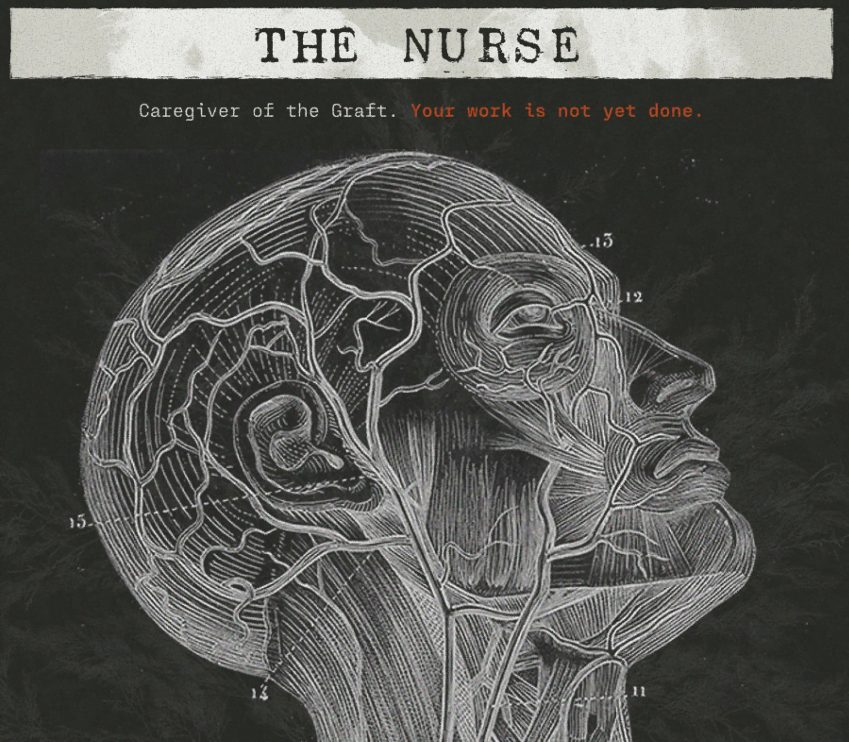
Tendon is a free 40-page zine by Davino, Porter, and Rupp, who have previously released a few collaborative projects on Davino's itch page. Styled as a "symbiotic survival horror" game, the premise is striking: you play "Nurses," explorers and tenders of a giant biomechanical obelisk in an otherwise lifeless desert. The obelisk (called the Graft) rearranges itself in real time; new horrors blossom each day. The Nurses are deeply attuned to the Graft's ecosystem, but harsh desert life forces them to tear into its guts just to survive. It's the kind of shit that gives you those good brainworms. Very Rain World. Are Tendon's juices worth the squeeze? Let's find out.
What's Inside?
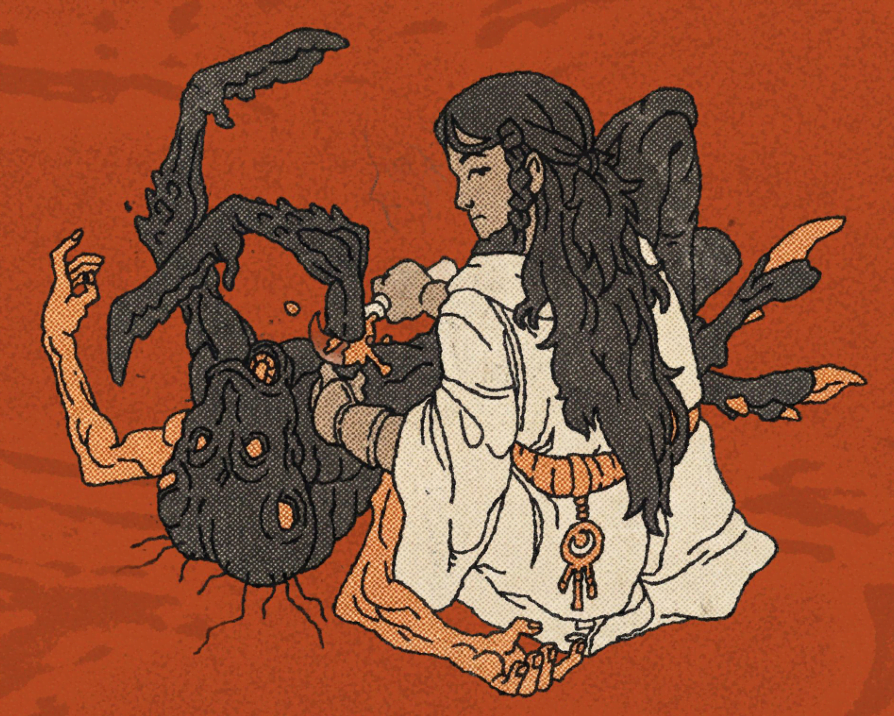
A ton of sauce in a small package. Tendon wastes no time in giving you the whats and whys of your character: Nurses eke out a living in a tiny colony at the base of the Graft, supported by distant, blurry merchant corps with a vested interest in the Graft's harvest. Anything worth having, from food to exploration items, is only bought with company scrip. The only way to earn scrip is to delve into the Graft, hack together "tools" from the bodies of its inhabitants, and sell off anything useful to your faceless LLC of choice.
It's a cruel cycle. The weight of extractionary wealth hangs heavy over the settlement. It's inescapable. The merchant's stranglehold isn't something you can defeat through violence - they're here via proxy. Even the Graft's deepest treasures only help you survive, not escape, this system. This is all accompanied by some beautiful prose that hits the vivid, gnarly imagery I want from bio-horror while staying bleak and uncompromising with life outside the Graft.
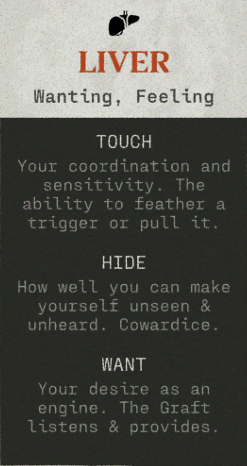
But how does it play? Bundled inside this nightmare world is a resolution system that seems... fine? It's hard to get a feel without seeing it in action. Barring specific environmental challenges, you only roll in contest with the Graft's inhabitants (called Seeds). Each side builds a dice pool and compares rolls. Higher matching die means a stronger effect, but more matching die means the action happens faster. Ostensibly this means you might roll something like 5/5/5/9/9 and have to choose between an effect that's weaker but faster than the enemy's rolls or stronger but slower.
I'm not sure how many interesting decisions this will make in practice (my gut says fewer than you'd think), but I do like how it shapes gameplay: your main language for interfacing with the world isn't always violent, but it is always in contest. Seeds share the same stats and skills as Nurses, so the contest is symmetric. No matter how much or little they resemble you, your only mechanical overlap is fraught. It's exciting flavor.
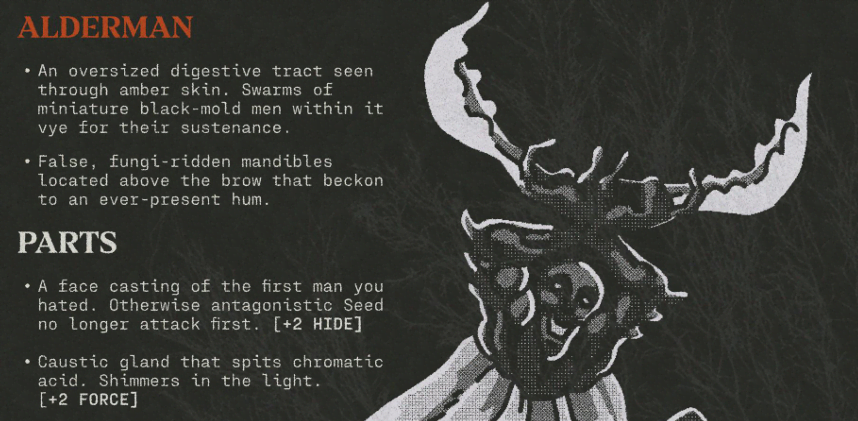
Almost half of the zine is devoted to random generation for the Graft's rooms and denizens, and it can't be expressed how hard the text goes. Every element of every room had my mouth agog. It reminded me of stumbling through The Vorrh. The procgen also comes with a killer gimmick: different sections of the Graft are generated based on the real-time hour of play. If you always start your games at noon, you'll always roll a different Graft compared to groups who play in the morning. I love this, and I think the authors do too because they even point out the best part in the text: most groups play at regular hours, so they'll only ever see one or two sections of the Graft. But the rest still exists, shifting and growing while the table is empty. The Graft is an ecosystem, and if you want to truly explore you have to play on its terms.
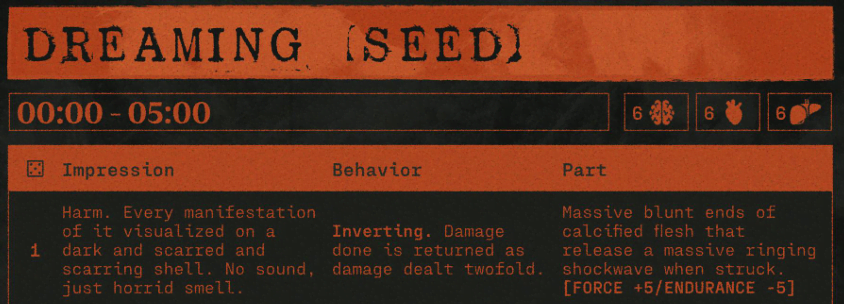
God, this shit rocks. It gets me feverish in the same way as UVG or the Stygian Library - I'm obsessed with texts that feel larger than the page. The Real Time of it all infects other parts of the zine, too. Nurses need enough to food to eat every 24 hours, even when you're not playing. If you leave a dead Seed behind when the labyrinth shifts, its genetic makeup gets absorbed into that section of the Graft and can mix into future Seeds. In fact, the act of playing the game is framed as "a transitory window of control" in which you embody the Nurses. It captures a feeling I've been reckoning with as someone who can often only fit in one session a month - the strangeness in playing a character after too much time has passed. The sense memory that guides you when you pick them back up, the metamorphosis into old flesh. Like wriggling into skin that doesn't fit the same anymore.
Is There Anything I Didn't Like?
I don't know what this means.
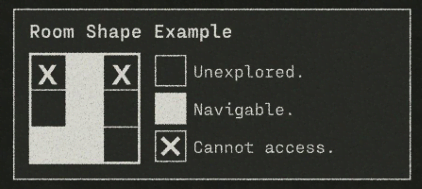
Navigable and "cannot access" both track, but what does "unexplored" mean? This is a roguelite, it's all unexplored. Is it implying some parts of the room have a clear path but others have like, vines or something blocking your vision? That's how I'd rule it. Is that interesting? Not really. There's also some confusing overlap between individual sections of a room (a 3x3 grid) and the rooms themselves - both seem referred to interchangeably as "squares". This is the only slice of the zine that really doesn't feel inspiring and is the first piece of dead tissue I'd look to cut at the table.
I thought at first this could be inspiration for traps and environmental hazards, but those are covered by a different section of the procgen that feels both disconnected from the shape itself and also not fully baked. The imagery goes crazy but the mechanical effects don't. Here are a few examples for gamers playing between 6 and 8 AM:
A warm room with thick, industrial plastic curtains. Sheetmetal palm trees sprout from dark wounds in the floor. Something bright shimmers through plastic roots. Requires [FORCE 2x2+] to push through.
A room that cannot be seen, only heard. There is a new language to the not-walls walls that guides the way. Requires [SYNTAX 2x6+] to pass through.
These aren't interesting problems to solve, they're taxes. The former is easy to rule around if a player gets creative with Seeds or their own tools, but the latter has nothing. What happens if they fail the roll? I guess a Seed wanders in or something and then they slap dice around until the loading screen finishes and they can move on? It's missing an interesting consequence for failure. As much as I hate to cut good prose, I think the game is better served by problems with like, a baseline tangibility lol. Investigating the environment and navigating it creatively within the fiction is both more fun and, IMO, more in line with the vibe of intimately learning an ecosystem than abstracting stuff out to a dice tax.
This stuff sticks out not because it's atrocious or anything I can't improvise around at the table, but because everything surrounding it is so good. With a world this electric, I'd like to see mechanics to match!
Flavor Packet: 1d6 Temporal Splices
When I review something, I like to write a little mini-expansion to show how crucial the act of being inspired by other's work is for our shared hobby. As far as content goes, the most open space to flesh out comes in the form of the merchants buying up the Graft and the items they offer. The zine offers a few groups, and these have just as much sauce as the icky gooey stuff inside the Graft, but it's still only a few short pages.
However, I'm feeling drawn to the real time gimmick. It all makes sense if you're playing in-person in the same time zone, but what happens if you're playing digitally, potentially with someone across the world? Obviously you just pick a time and roll with it, but I thought I would imagine what happens when you enter the Graft through two windows of control that don't quite match cleanly.
- Your Nurse fragments. One explores in the table's time, the other explores in yours. Roll WANT: on 4x4+, the other you survives and is outside when you exit.
- Genetic mistype. Roll a Seed from each unique time zone; the GM constructs an amalgamation from the results. The Graft bristles in its presence, cancerous.
- Each new room, another player becomes the GM and generates per their current time. The new GM's Nurse disappears between doorways. If you're GMing when they exit the Graft, your Nurse is lost.
- Only Nurses in the same time slot can play together. Everyone else creates and plays a Seed from their time slot, displaced, distraught.
- Your Nurse rejects your control. They stretch and crack. Take a random Injury for each time slot removed you are from the table's.
- Just change your system clock to match the rest of the table. If you do, a microscopic mole burrows through the Graft and obnoxiously announces you to all nearby Seed.
Final Thoughts
I rate Tendon uncountable dreams of another life out of ten. Good shit. Please finish this game and then remake it with all new rooms and then do a game jam supporting it and then do a printed expanded edition et cetera. I just want to see more work from this crew.
You can download Tendon for free here. It's in active testing, and they'd love feedback.